Deprecated: Return type of Ai1wm_Recursive_Directory_Iterator::hasChildren($allow_links = true) should either be compatible with RecursiveDirectoryIterator::hasChildren(bool $allowLinks = false): bool, or the #[\ReturnTypeWillChange] attribute should be used to temporarily suppress the notice in /home/stagingaliansoft/public_html/wp-content/plugins/all-in-one-wp-migration-unlimited-main/lib/vendor/servmask/iterator/class-ai1wm-recursive-directory-iterator.php on line 57

Deprecated: Return type of Ai1wm_Recursive_Directory_Iterator::rewind() should either be compatible with FilesystemIterator::rewind(): void, or the #[\ReturnTypeWillChange] attribute should be used to temporarily suppress the notice in /home/stagingaliansoft/public_html/wp-content/plugins/all-in-one-wp-migration-unlimited-main/lib/vendor/servmask/iterator/class-ai1wm-recursive-directory-iterator.php on line 35

Deprecated: Return type of Ai1wm_Recursive_Directory_Iterator::next() should either be compatible with DirectoryIterator::next(): void, or the #[\ReturnTypeWillChange] attribute should be used to temporarily suppress the notice in /home/stagingaliansoft/public_html/wp-content/plugins/all-in-one-wp-migration-unlimited-main/lib/vendor/servmask/iterator/class-ai1wm-recursive-directory-iterator.php on line 42

Deprecated: Return type of Ai1wm_Recursive_Extension_Filter::getChildren() should either be compatible with RecursiveFilterIterator::getChildren(): ?RecursiveFilterIterator, or the #[\ReturnTypeWillChange] attribute should be used to temporarily suppress the notice in /home/stagingaliansoft/public_html/wp-content/plugins/all-in-one-wp-migration-unlimited-main/lib/vendor/servmask/filter/class-ai1wm-recursive-extension-filter.php on line 47

Deprecated: Return type of Ai1wm_Recursive_Extension_Filter::accept() should either be compatible with FilterIterator::accept(): bool, or the #[\ReturnTypeWillChange] attribute should be used to temporarily suppress the notice in /home/stagingaliansoft/public_html/wp-content/plugins/all-in-one-wp-migration-unlimited-main/lib/vendor/servmask/filter/class-ai1wm-recursive-extension-filter.php on line 37

Deprecated: Return type of Ai1wm_Recursive_Exclude_Filter::getChildren() should either be compatible with RecursiveFilterIterator::getChildren(): ?RecursiveFilterIterator, or the #[\ReturnTypeWillChange] attribute should be used to temporarily suppress the notice in /home/stagingaliansoft/public_html/wp-content/plugins/all-in-one-wp-migration-unlimited-main/lib/vendor/servmask/filter/class-ai1wm-recursive-exclude-filter.php on line 41

Deprecated: Return type of Ai1wm_Recursive_Exclude_Filter::accept() should either be compatible with FilterIterator::accept(): bool, or the #[\ReturnTypeWillChange] attribute should be used to temporarily suppress the notice in /home/stagingaliansoft/public_html/wp-content/plugins/all-in-one-wp-migration-unlimited-main/lib/vendor/servmask/filter/class-ai1wm-recursive-exclude-filter.php on line 37

Deprecated: Return type of Ai1wm_Recursive_Newline_Filter::accept() should either be compatible with FilterIterator::accept(): bool, or the #[\ReturnTypeWillChange] attribute should be used to temporarily suppress the notice in /home/stagingaliansoft/public_html/wp-content/plugins/all-in-one-wp-migration-unlimited-main/lib/vendor/servmask/filter/class-ai1wm-recursive-newline-filter.php on line 28
alian, Author at Alian Software https://staging.aliansoftware.net/author/alian/ Best Web & Mobile App Development Company Thu, 16 May 2024 12:17:35 +0000 en-US hourly 1 https://wordpress.org/?v=6.8.3 https://staging.aliansoftware.net/wp-content/uploads/2022/08/favicon.png alian, Author at Alian Software https://staging.aliansoftware.net/author/alian/ 32 32 How influencer marketing can help your e-commerce store to grow? https://staging.aliansoftware.net/marketing/how-influencer-marketing-can-help-your-e-commerce-store-to-grow/ Sat, 08 Jul 2023 15:30:45 +0000 https://aliansoftware.com/?p=30051 The ecommerce industry, with 26 million companies, is expected to grow to $6.7 trillion by 2024. It offers convenience, speed, and efficiency, providing access to products 24/7 from the comfort of our homes.

The fastest way to accelerate your brand on social media is through Influencer marketing. Influencer marketing leverages social media popularity and influencers' followers to promote products or services, driving engagement and reaching target markets through genuine connections. Working with collaborators who not only create beautiful content but also make sales for you is the new trendy thing.

The post How influencer marketing can help your e-commerce store to grow? appeared first on Alian Software.

]]>

What are influencers?

An influencer is someone who has gained a reputation through social media in a specialized sector. They are internet celebrities with a large fan base. They are frequently rewarded with cash, free products, or even discounts on expensive products.

According to a recent study, 80% of marketers find influencer marketing to be effective. In addition, as per the Marketing Hub, 75% of business have a dedicated influencer.

Why does an Ecommerce business need Influencers?

Key characteristics of influential people are their credibility and trustworthiness. Their support of your e-commerce offerings may increase consumer trust in your company. Influencer marketing may be very powerful, but only if it is tailored to your specific demographic, sector, and overall marketing plan. Several methods exist for doing so, such as working together on a product, releasing a special edition, or holding a contest. Thus, working together with influential people may be a win-win situation that advances the interests of both sides.

Selecting the right influencer: One of the crucial points before even thinking about influencer marketing is to select the right influencer. By doing so it will help you to achieve your desired results.

Types of influencers

  • Mega influencers (celebrities) having over one million followers
  • Macro influencers with 500,000 to 1,000,000 followers
  • Mid-tier Influencers with a following of 50k to 500k.
  • Micro-influencers with ten thousand to fifty thousand followers

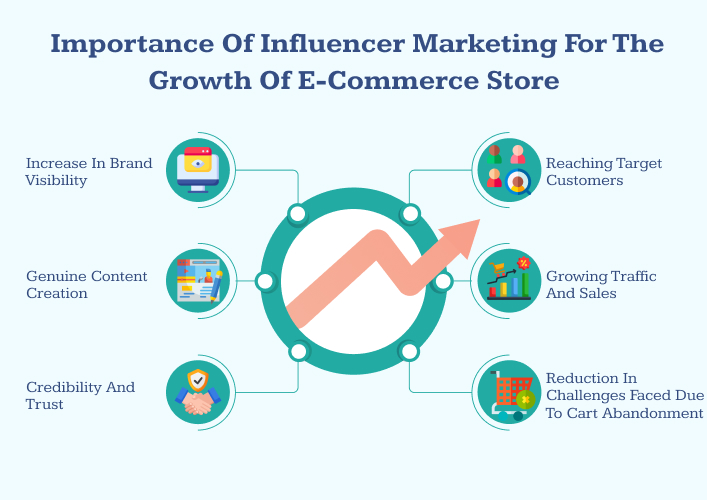
Importance of Influencer marketing for the growth of E-Commerce store

Importance of Influencer marketing for the growth of E-Commerce store

90% of consumers read reviews before buying the products as they are craving for originality and genuine recommendations. So let’s see how the growth of e-commerce business can be achieved with influencer marketing.

Increase in brand visibility

Using printed advertising material is no longer effective. Blogging without any promotional activities is outdated now. Influencer marketing is gaining popularity as it is more authentic and engaging than traditional advertisements.

Let’s use an online store as an illustration for this:

Through social media marketing, an online store receives 220k pageviews on a certain product. As a result, influencer marketing may assist you in organizing this type of giveaway to promote your goods and services. When these individuals submit detailed reviews of your products, it makes a fantastic impact and raises brand awareness.

Genuine content creation

Influencers are adept content producers who are aware of the tastes and passions of their audience. They frequently do it in a sincere and real manner when producing material to advertise an ecommerce store. Since the advertising content is more relatable due to its authenticity, engagement, and conversion rates are higher.

Credibility and trust

Building consumer trust, the cornerstone of your business is challenging. For new e-commerce businesses, establishing client trust is essential. Long-term consumer involvement results from it. On a number of sites, including Instagram, Facebook, YouTube, and Twitter, influencers have developed trust. Discounts and coupons have been proven to increase brand loyalty and conversions.

Reaching target customers

Influencers concentrate on a particular demographic. E-commerce companies can reach ideal customers by collaborating with influencers that have a following that is similar to their target market. This indicates that the products or services being promoted by the e-commerce store are more likely to appeal to the influencer’s followers who share their interests. This targeted marketing approach thus promotes stronger engagement and contact with potential clients.

Growing traffic and sales

The goal of all e-commerce firms is to increase sales and hit the target. As influencers have established a long-lasting trust people often buy the goods and services recommended by them. Hence it will lead to increased visitors to the site. Once the site starts getting traffic conversions are bound to happen.

Reduction in challenges faced due to cart abandonment

E-commerce faces a competitive market with over 7 million online retailers. The Baymard Institute found that two out of three users abandon their cart after browsing products. To drive conversions, e-commerce brands can leverage influencer promotion to connect with powerful influencers and well-known tools like Swaypay, Dealspotr, Heepsy, and even Shopify for Ecommerce stores.

Conclusion

In conclusion, influencer marketing may do wonders for an online shop’s success. When brands work with influential people, they get access to their audience and the reputation of the influencers themselves. Customers’ confidence in the suggestions of influencers may increase conversion rates and return on investment. Social proof and consumer engagement may be gained via user-generated content produced through influencer relationships.

FAQs

What is influencer marketing in Ecommerce?
Ecommerce influencer marketing is a type of marketing technique where companies work with internet influencers to promote their brands and products. The goal is to establish a connection with the influencer’s followers.
Does Influencer marketing work for Ecommerce?
By taking advantage of the popularity of the influencer, eCommerce firms are able to expand their audience base. This technique can assist eCommerce firms in meeting a range of marketing objectives, including brand exposure, online engagement, and conversion.
How to use influencer marketing in Ecommerce?
There is a number of ways to incorporate influencer marketing in Ecommerce. Firstly by launching an affiliate marketing program with the influencer. Secondly, collaborating with influencers to create the content. Finally, sharing the branded content through Influencer’s account.
How do you measure the success of influencer marketing for Shopify?
Track influencers’ impact on your Shopify store by providing discount codes and monitoring website impressions to measure customer reach and profit. Monitor engagement with influencer-made content to optimize your store’s marketing efforts.
How do you find influencers for the Shopify store?
By using filters for data, region, and demographics, influencer marketing systems like Aspire and Upfluence assist in locating Shopify Store influencers. Search features are available on social media sites like Instagram and TikTok.

The post How influencer marketing can help your e-commerce store to grow? appeared first on Alian Software.

]]>
Tips on Launching a New Product to Online Market https://staging.aliansoftware.net/e-commerce/tips-on-launching-a-new-product-to-online-market/ Wed, 05 Jul 2023 15:40:58 +0000 https://aliansoftware.com/?p=29565 Launching a new product may be both thrilling and daunting. Businesses must use excellent marketing strategies to properly advertise their product ranges. Making decisions based on data is crucial for boosting brand recognition and minimizing industry risks.

According to Harvard Business Review, there are a majority of the reasons for the failure of the new products. Without proper strategies, even the best products may be ignored, making it difficult to promote and sell online.

Careful planning and execution are of utmost importance to beat the competition and become successful.

The post Tips on Launching a New Product to Online Market appeared first on Alian Software.

]]>

Why is it important to have a product launch strategy?

Importance of Product Launch Strategy
It is impossible for a brand to get market penetration without a proper product launch strategy. The cornerstone of a product launch strategy determines the appropriate moment and market for the product. It not only avoids unnecessary marketing campaigns, but it also aids in target identification, ensuring good sales.

When launching a new product, make certain that the appropriate product marketing plan is implemented. That can be customized when it comes to product launch strategy. A technique that works for fast-moving consumer goods (FMCG) may not work for electronics.

Types of product launches?

Basically, there are two types of product launch – hard product launch, and soft product launch

  • Soft launch: Soft launch is a test launch of a product for a specific audience, evaluating performance and eliminating issues in the beginning stages, similar to a Beta Launch.
  • Hard launch: Hard product launches are grand events held by big brands, such as Apple, to promote their products. These events create hype and attract customers worldwide, making them more popular.

Steps to Take while Launching a New Product

To stay on top, follow these steps to launch your product online more effectively.

Conduct Research for your target audience:

Before even launching a new product, it is critical to take a tour of the market and do research regarding

  • Who is your target audience?
  • What problem are you trying to solve?
  • How is it going to benefit your customer?
  • What age group does your audience belong to?
  • Which comparable products are they using now?
  • How to encourage them so they will easily switch from the old product to the new one? The list goes on and on.

Defining your unique selling proposition(USP):

To stand out in the competitive online market, define your unique selling proposition (USP) by emphasizing its unique features, exceptional quality, convenience, and reasonable pricing. Utilize methods like landing pages, beta testing, prototypes, and pre-sales to gather feedback and reviews on demand, pricing, and usability.

Creating a strong online presence:

A solid internet presence is essential for a successful product launch. Make a well-designed website that highlights your product while also providing a seamless user experience. Improve your website’s visibility by optimizing it for search engines. Create an active presence on social media channels where your target demographic is likely to interact. Produce high-quality content that educates, entertains, and informs your audience on a regular basis.

Secure your online presence:

Cybersquatters have been known to target customers who failed to protect their domain name, trademark, social media profiles, etc. in the modern world. Before beginning any venture, it is essential to secure all of these. Your domain name and other important marketing tools can frequently be held for a very hefty price, and hiring solicitors is never cheap!

Generating a pre-launch giveaway:

To boost a new online product’s success, create anticipation and excitement weeks or months in advance through pre-launch giveaways and contests. Offer exclusive prizes to participants in exchange for spreading the word about the product. Create viral content, encourage social media participation, and offer extra points for product referrals. Be creative and avoid spam messages.

Creating a Launch Plan for a new product:

A launch strategy is crucial for a successful product launch, laying out objectives, strategies, tactics, and schedules. It should include KPIs, channels, budget, resources, timeframe, milestones, and risks. A well-defined vision, realistic timeframe, and measurable outcomes increase the likelihood of success. A launch plan serves the purpose of organizing resources, aligning teams, and conveying the vision.

Analyzing and optimizing your new product online:

After your product has been out, it’s crucial to evaluate and improve your performance. Measure your outcomes, assess your achievement, and pinpoint your areas for development. Data on product usage and satisfaction, marketing efficiency and ROI, customer feedback and retention, sales, and revenue, as well as issues and opportunities, can be collected and analyzed using methods like analytics, questionnaires, or interviews. You can gain knowledge from your experience, make wise choices, and enhance your product and marketing through analysis and optimization.

Conclusion

Launching a new product is not a one-time event; it requires ongoing effort and adaptation. Stay connected with your customers, listen to their feedback, and continuously improve your product and marketing strategies. With dedication, persistence, and a passion for delivering value, your online product launch can become the catalyst for long-term success.

FAQs

Is timing important for the new product launch?
Businesses can take advantage of seasonal demand, recent trends, and market demands while launching a new product and can stay ahead of the competition.
How do you attract customers for new product launches?
You can attract customers for new products by offering discounts and running promotions and referral policies.
Why USP is important for a new product launch?
Unique selling points are of utmost importance for a new product launch as without them you can not stand in this competitive market. It will clearly help your audience to understand why they should buy your product as compared to others.
In what circumstances should you delay the launch of the new product?
When there is a pandemic or war situation it is advisable to delay the launch of the new product as you might not get the result and all your efforts may go in vain.
What is important when launching a new product?
Launching a new product requires considering timing, pricing, packaging, promotion, target market, competition, testing, reviews, and a strategic marketing approach.

The post Tips on Launching a New Product to Online Market appeared first on Alian Software.

]]>
Points to Think About When Creating an SEO Friendly online store https://staging.aliansoftware.net/e-commerce/points-to-think-about-when-creating-an-seo-friendly-online-store/ Sat, 01 Jul 2023 15:30:37 +0000 https://aliansoftware.com/?p=29462 Are you planning to open an online store that not only attracts customers but also generates traffic? Don't know where to start? Don't worry, in this comprehensive guide, we will guide and help you to reach an appropriate conclusion.

A properly optimized SEO friendly online store is a necessity if you are selling things and want to reach the largest audience possible.

Why? Well, having an online store has a number of advantages.

The most obvious justification for opening an online store is to benefit from the global e-commerce industry's explosive growth. According to Statista, overall sales will be valued at $8 trillion by 2026.

Before even jumping on how, let's first understand why you should have SEO friendly online store. It is said that if your why is clear how becomes simple. So let's dive in.

The post Points to Think About When Creating an SEO Friendly online store appeared first on Alian Software.

]]>

Why is it important to have an SEO friendly online store?

Prioritizing SEO methods for a new online store can result in :
  • Enhanced trust
  • Increase in Visibility
  • Better user experience
  • More visitors
  • Higher Sales

Online SEO friendly stores involve in making website pages more effective so they may rank well on search engines like Google, Bing, and Yahoo. Through Google Ads, organic SEO rankings are not purchased. The ranking is determined by criteria, formulas, and algorithms used by search engine corporations. According to a survey, 92% of visitors land on the first page of a Google search for their needs.

Here are some basic points to keep in mind while creating an SEO Friendly online store.

Define your target audience:

Who are your people? The first thought that comes to mind before developing an online store is to research the market and identify your target audience in accordance with your marketing plan.

To improve web design, content, blog entries, and marketing activities, collect data on target audience demographics such as browsing behaviors, shopping locations, and search volume. This is essential for successful website planning and execution.

Do solid Keyword Research for SEO friendly online stores:

Keyword research for online stores is essential for increasing internet visibility. High-search-volume keywords can be discovered with tools such as

Due to factors such as competitiveness, monthly searches, word difficulty, seasonality, and trends, it is pivotal to do keyword research.

Optimizing on-page for SEO Friendly online store:

Optimize your online store’s pages for search engines by incorporating relevant keywords in

  • SEO Title: It is the top blue line in Google search results, with a 70-character long title and a few keywords.
  • Meta Descriptions: They are the text below the title, previewing the page’s content, and can be 320 characters long.
  • Images: They are crucial for ranking, archiving, and delivering results. Name images with keywords and descriptive details.

Not to forget to keep your URL clean and insert keywords where possible.

Making Online stores mobile friendly
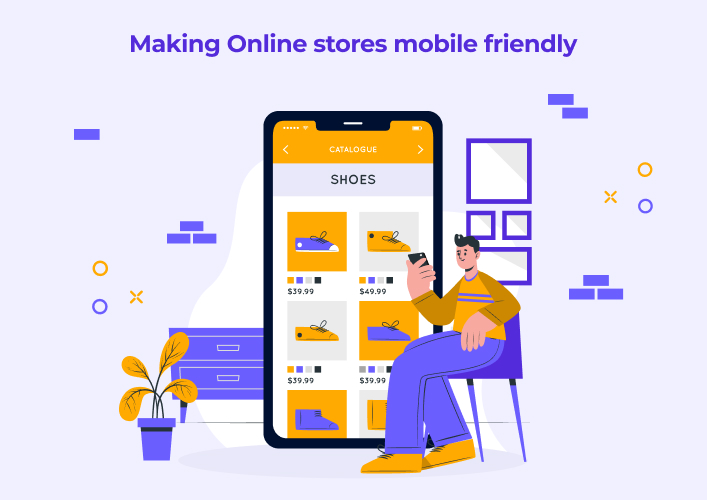
Making Online stores mobile friendly
Making online stores mobile-friendly is crucial for SEO, as 60% of traffic in 2023 was generated by mobile devices. Cross-device shopping is increasing, making a consistent buying experience essential. Optimize website loading speed and avoid close buttons. Use Google tools like mobile-friendly tests and page speed tests. If you are in search of the best mobile app development company then your search ends here.

Improving your SEO with E-E-A-T :

E-E-A-T, or Experience, Expertise, Authoritativeness, and Trustworthiness, is an important factor in SEO since it helps establish trustworthiness. In 2019, Google confirmed that it is a crucial part of their algorithms. It is important for ranking and is getting increasingly popular in a variety of areas. Create dedicated pages for authors, assign authors to blog content, and bring in specialists for specific content to highlight EEAT.

Developing Internal Linking Strategy:

Internal linking is critical for the functionality and usability of a sitemap. Links that are strategically positioned move users through the site, increasing authority and promoting link equity. Removing orphaned pages improves search rankings, and search engine optimization, lowers bounce rates, enhances page views, and boosts conversions.

Implementing analytics and monitoring tools:

There is no SEO without tools. Analyzing core metrics is essential for creating an SEO-friendly website. Free tools like Google Search Console and Google Analytics offer valuable insights into performance, organic traffic, and potential issues like duplicate content, incorrect meta tags, and broken links.

Backlinking building for SEO friendly online store:
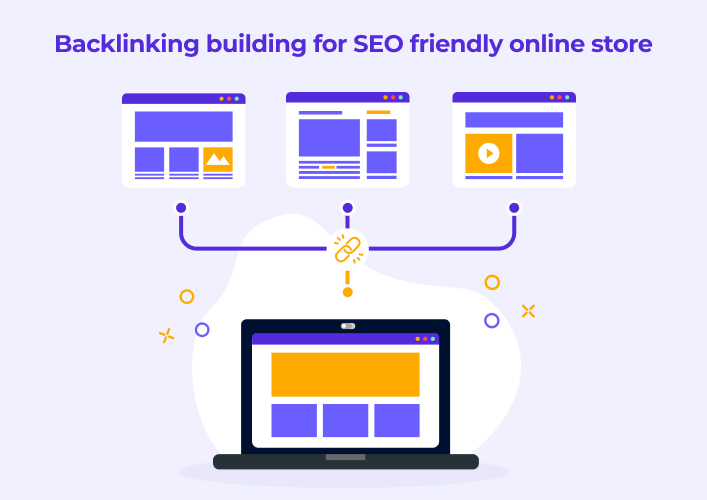
Backlinking building for SEO friendly online store
Create a plan to get backlinks from websites in your respective field. It will not only boost the exposure but also the rankings of your online store on the search engines like Google and Bing.
To Wrap it Up

SEO is crucial for internet marketing strategy, increasing brand credibility, and user experience, and reducing costs. Well-optimized websites require planning and considering SEO, as it saves time, effort, and money for future changes. These tips and examples are helpful for designing SEO friendly online stores.

FAQs

Which free SEO tools can be used for online stores for keywords?
If you are running low on your budget, free SEO tools like Keyword.in, Screaming Frog and Mozbar can be used for your online stores.
How to promote an online store through SEO?
The main idea behind promoting online stores is to increase user experience and maximum the conversion rate.
What is an effective SEO strategy for an online store?
SEO strategy organizes website content by topic to improve search results visibility and organic traffic from search engines.
What is the first step to start SEO for an online store?
Defining relevant keywords is crucial for creating search-engine-optimized website content and building themes.
How does SEO attract customers?
SEO involves understanding customer searches and engaging content to connect, convert, and expose brands effectively.

The post Points to Think About When Creating an SEO Friendly online store appeared first on Alian Software.

]]>
Shopify Payments vs Paypal – Which payment method to choose for the Shopify store? https://staging.aliansoftware.net/design/shopify-payments-vs-paypal-which-payment-method-to-choose-for-the-shopify-store/ Wed, 28 Jun 2023 15:26:47 +0000 https://aliansoftware.com/?p=29361 Payment is the make-or-break phase for E-Commerce enterprises because it determines if your order will be successfully placed or not. This is why Shopify store owners spend hours researching the many payment methods that Shopify offers.

If you are not using the most convenient, quick, and hassle-free choice for your business, you can be losing out on sales that you bring to the table. Your decision will not only affect the amount of money you make online but also your conversion rates.

The post Shopify Payments vs Paypal – Which payment method to choose for the Shopify store? appeared first on Alian Software.

]]>

What is the main difference between Shopifpayments and Paypal?

What is the main difference between Shopifpayments and Paypal
One of the biggest e-commerce platforms, Shopify, now has its own payment system called Shopify Payments. However, one of the most well-known and oldest reliable methods for online payments is PayPal.

Shopify payment Overview:

Shopify, which is used by millions of stores, is one of the most well-known ecommerce systems worldwide. The biggest and most significant Paypal substitute has been added by Shopify, and it is called Shopify Payments.

It is not only used in the United States but also in 23 other countries.

How Shopify Payments Works

Integration directly into the Shopify platform is possible as Shopify Payments are powered by Stripe. With lower fees and other payment services, it allows ecommerce store owners to start accepting credit cards. Your customer’s payments can be accepted with Shopify Payments using :

PayPal Payment Overview:

One of the biggest and most well-liked payment options available globally is PayPal. By connecting bank accounts and credit cards to an account, PayPal functions as a “digital wallet,” making it simple for users to make payments for goods and services online. More than 200 countries are home to about 430 million PayPal users, and PayPal is accepted by millions of online shops and marketplaces.

How Paypal works

  • Paypal allows big and small businesses to accept payments from consumers that use their “digital Wallet” through its own payment processing system. A faster, easier checkout process for shoppers is around the world through Paypal as it integrates with a large number of ecommerce platforms. Your client can pay you through PayPal by
    • Visa
    • Mastercard
    • American Express
    • Discover

Before taking the decision let’s do a quick analysis of the terms like cost and fees, processing time and payout, charges and dispute resolution, and customer support.

Shopify payment Vs Paypal: Fees

Shopify Payments are just like other payment processors that include:

  • Processing fees per transaction: 2.4% – 2.9% + 30c USD for online credit cards.
  • Foreign exchange fees: For the U.S. it is 1.5% and for all other countries it is 2%.

In order to use the services Shopify requires Businesses to pay a monthly fee. There are 3 options—- Basic, Shopify, and Advanced that range between $39 and $399 per month. The most expensive accounts provide lower rates.

PayPal charges normal industry fees, just like the majority of other payment processors such as:

  • Processing fees per Transaction: 5.4% + 30 USD for online credit card purchases, and 2.29% – 3.49% + 9 USD for in-person credit/debit card purchases.
  • Foreign exchange fees: 4.5 percent The integration of PayPal into your e-commerce platform is free. You only pay when transactions are processed, not on a monthly basis.

Shopify payment Vs Paypal: Payout

Shopify Payment generally takes 3 days to reflect the money in your bank account by electronic transfer. However, it may even vary depending on your location.

On the other hand, Paypal normally takes 5 to 7 working days to reflect the money no matter where your business or account is located.
So in this case again Shopify Payment has an edge due to less processing time.

Shopify payment Vs Paypal: Charges and Dispute Resolution

If there is a disagreement with Shopify Payments, Shopify will consider the claims of both parties and reach a conclusion within 60 days. If the customer’s allegation is more compelling, they might get their money back while you might get hit with a $15 fine. Your account may be locked if the problem persists, which could have an impact on sales and consumer loyalty.

On the contrary, if a chargeback occurs, PayPal disputes can also take up to 75 days to resolve and cost store owners $20. Money in the account is frozen while PayPal makes its decision, and customers and retailers have 10 days to provide supporting documents. So again Shopify payment is the winner.

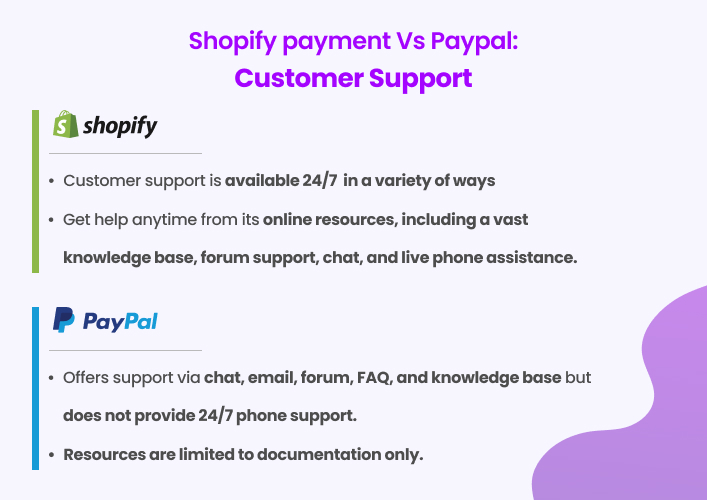
Shopify payment Vs Paypal: Customer Support

Shopify payment Vs Paypal_ Customer Support

Customer support is available 24/7 in a variety of ways in Shopify. You can get help anytime not only from its vast online knowledge base and forum support but also in the form of chat and live phone. Even your billing inquiry will be entertained via email.

On the other side, Paypal offers support via chat, email, forum, FAQ, and knowledge base but does not provide 24/7 phone support. Its resources are limited to documentation only. So again Shopify payment wins.

Conclusion

Don’t complicate the process of payment. The easier and faster it is for your customers to pay, the faster your bank account will grow.
Why limit yourself to just one payment option, such as Shopify Payments or Paypal, when there are multiple others accessible for your convenience? Finally, the decision is yours, as both of these options serve your purpose.

FAQs

Which payment method is easier to set up on Shopify Store?
Shopify Payments is built directly into the Shopify platform, making it simple to set up and utilize. PayPal integration with Shopify is similarly simple, but it involves the creation of a PayPal Business account and the configuration of the integration settings.
Are there any additional features or services offered by Shopify Payments or PayPal?
Shopify Payments includes features such as built-in fraud detection and chargeback protection. PayPal provides consumer and seller safety and dispute resolution.
Are Shopify Payments as safe as Paypal?
Yes, Shopify has many of the same security features just as Paypal like Fraud filter, SSL Certificate, and PCI compliance.
Which is better to use Shopify Payments or Paypal?
Shopify payment is a better option for your budget as compared to Paypal.
Which payment method supports more countries and currencies?
Shopify Payments is available in United States and 23 other countries whereas PayPal is widely accepted throughout the world and supports 200+ countries.

The post Shopify Payments vs Paypal – Which payment method to choose for the Shopify store? appeared first on Alian Software.

]]>
PrestaShop Vs Shopify: Examining the two powerhouses in the Ecommerce World. https://staging.aliansoftware.net/design/prestashop-vs-shopify-examining-the-two-powerhouses-in-the-ecommerce-world/ Sat, 24 Jun 2023 15:30:47 +0000 https://aliansoftware.com/?p=29305 Are you thinking about selling your first product online? Or are you planning to migrate your online store to a better ecommerce platform? In both scenarios, you have landed in the right place. In this blog post, we will compare PrestaShop and Shopify< to help you to decide which online store builder is the perfect choice for your ecommerce business.

The post PrestaShop Vs Shopify: Examining the two powerhouses in the Ecommerce World. appeared first on Alian Software.

]]>

What is the difference between PrestaShop and Shopify?

The main difference between PrestaShop and Shopify is PrestaShop is an open-source eCommerce platform with customization options, while Shopify is a subscription-based e-commerce platform with a simpler, user-friendly experience. PrestaShop offers more customizing flexibility but requires more technical knowledge, while Shopify is less customizable but easy to use.

PrestaShop Vs Shopify – How to Choose the right platform?

Knowing strengths and weaknesses will not only help you to look to the future but also give you an edge to choose between the two after a detailed analysis. So let’s start.

Prestashop Vs Shopify – Pricing

The $5/month lowest plan from Shopify simply lets you add products and take payments through Shopify payment gateways on an existing store. Choose one of the following options if you want to build a fully functional internet store:
  • The basic Shopify plan is $29.
  • The shopify plan is for $79.
  • The advanced Shopify plan is $299.

PrestaShop, on the other hand, is open-source and free. You may download and install it wherever you want and use it for as many projects as you like. Just keep in mind the expenses of the hosting services needed to get your site up and operating.

Depending on the plan you pick, the additional cost for web hosting in PrestaShop can range from $4 to $14 per month. There may be additional costs for an SSL certificate or a subdomain(if you want). Despite the fact that there is no monthly fee in Prestashop, Shopify has a price advantage due to its advanced features.

Prestashop Vs Shopify – Themes

Prestashop Vs Shopify - Themes

Your Shopify account comes with 9 free themes by default, and you can access 70 additional paid designs in the application’s official repository. PrestaShop’s marketplace, on the other hand, has over 2,500 themes, with thousands more accessible on third-party websites. Overall, PrestaShop offers more options, while Shopify allows you simpler design customization.Thus Prestashop wins.

Prestashop vs Shopify – Performance

Because Shopify is a hosted platform, it is the service provider’s responsibility to guarantee that your site runs successfully. By joining up, you are putting your confidence in the platform to keep your store going. It takes less effort to optimize the Shopify store.

With PrestaShop, you have to take on a lot more responsibility. The performance of your website is affected by a variety of factors, including the hosting environment and the amount of plugins you install. So in this case also Shopify has an advantage over Prestashop.

Prestashop Vs Shopify – Support

Shopify is a premium platform, and consumers can rely on a team of specialists that know the platform through and out and are available 24/7. If you have requested a callback, you can access official help by live chat, email, or phone.

PrestaShop also provides official assistance via a ticketing system, however, access is limited to customers who pay a little more than $300 for a premium support subscription. Those who are unable to pay the additional charge can rely on the global PrestaShop community and publicly available support articles and lessons. Shopify wins the game again.

Conclusion

In the PrestaShop vs Shopify battle, both platforms serve distinct business needs. Shopify shines in terms of usability and scalability, making it a fantastic alternative even for one with no technical knowledge or looking for a hassle-free experience. PrestaShop excels at customization and flexibility, attracting enterprises with unique requirements and technical competence. Choose intelligently, keeping in mind your specific business goals, and prosper in the e-commerce world!

FAQs

What is the main difference between Prestashop and Shopify?
PrestaShop is an open-source eCommerce platform with customization options, while Shopify is a subscription-based e-commerce platform with a simpler, user-friendly experience.
Which is more expensive in Prestashop Vs Shopify?
Prestashop is open source so it is not more expensive than Shopify for small businesses.
Which is easier to use: Prestashop or Shopify?
Getting started with Shopify is much more straightforward and easier as it is a hosted platform where the responsibilities of installation and configuration do not lie on your shoulders. However, in Prestashop, you have to depend on your technical team to help you out.
Why do people prefer Shopify over Prestashop?

People prefer Shopify due to its strong capabilities like marketing automation, integrated payment processing, and other service connectors. Additionally, Shopify offers a selection of support services, including 24/7 customer care, access to forums, and online tools which are missing in Prestashop.

Which is better: PrestaShop or Shopify?
It is entirely dependent on the requirements and goals of the firm. If you want an easy choice, go with Shopify, but if you want to start a small business go with Prestashop.

The post PrestaShop Vs Shopify: Examining the two powerhouses in the Ecommerce World. appeared first on Alian Software.

]]>
Weebly vs Shopify – A Brief Comparison https://staging.aliansoftware.net/design/weebly-vs-shopify-a-brief-comparison/ Wed, 21 Jun 2023 15:28:27 +0000 https://aliansoftware.com/?p=29265 The success of your online business depends on your selection of the best platform in the ever-expanding world of e-commerce. Two prominent solutions that are frequently mentioned among the many alternatives are Weebly and Shopify. Both platforms include a variety of tools and capabilities to support the development and expansion of your online business.

Weebly and Shopify will be compared against one another in this blog article in terms of cost-effectiveness, marketing features, payment methods, and customer support. Let's start the comparison of Weebly vs Shopify and find out which platform is ideal for your online business.

The post Weebly vs Shopify – A Brief Comparison appeared first on Alian Software.

]]>

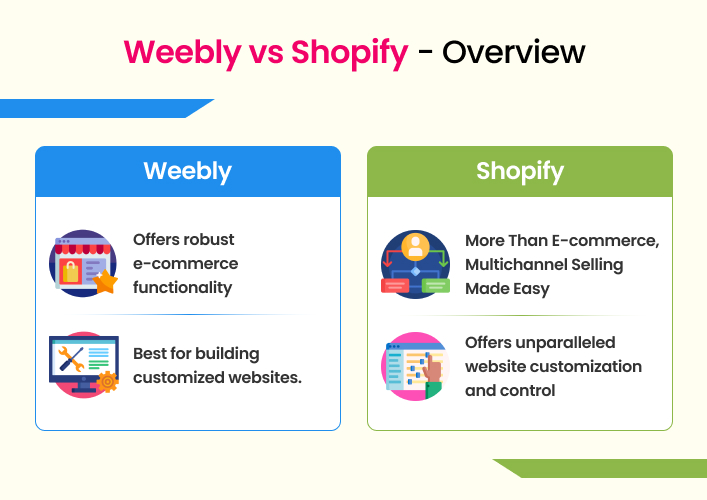
Weebly vs shopify – Overview

Weebly vs shopify - Overview

Not only being an e-commerce platform, Shopify also offers multichannel selling on platforms like Amazon, Facebook, Instagram, and more. It’s also perfect for high-volume sellers who want to sell through in-app purchases and various websites. Online marketplace, in-app, or multichannel sales are not supported by Weebly.

As a result, many new businesses and smaller e-commerce outlets utilize Shopify to manage a single online storefront while making use of its multichannel sales features.

On the other hand, Weebly is best for building customized websites. Although Weebly has a lot of e-commerce features, Shopify still has an edge in that you have almost complete control over how your website looks and feels.

Weebly provides you with more than 100 lovely free plug-and-play website themes. Only eight free themes are offered by Shopify, and they are all fairly simple. You should budget about $180 for a premium Shopify theme if you want more design options.

Using Weebly’s drag-and-drop page builder, you can then edit any page on your website from that point on. Using Weebly’s simple design tools, you can move titles, add slider images, create galleries, and more.

Similarly, you can alter the colors, images, fonts, and layouts on Shopify, but their design tools are incomparably inferior to Weebly’s.

Weebly vs Shopify – Cost-effectiveness

Only Weebly offers a free website option, and its free plan enables you to sell any kind of physical or digital goods or services. Weebly also offers three paid plans, each of which has progressively more advanced marketing and management capabilities.

It’s important to note that Shopify’s $29 Basic website plan costs less than Weebly’s most expensive $26 Performance plan. While Shopify plans offer more features as you move up the levels, they are significantly more expensive than Weebly’s top-tier plans at $79 and $299 monthly.

Weebly and Shopify offer unlimited product coupon codes, and secure SSL website hosting in all plans but some major differences that need to be mentioned. Weebly’s Free and personal plans display advertisements on your website whereas advertisements are not displayed on any plan in Shopify.

Weebly Vs Shopify – Marketing Features

Marketing is critical for acquiring consumers and increasing sales. Even on its free plan, Weebly includes marketing services like email marketing. Abandoned Cart Recovery is available to merchants in all three Shopify tiers, but it is only available in the Weebly Business Plus package. This allows you to interact with consumers and maybe regain lost purchases.

Shopify, on the other hand, offers a wide selection of marketing options, including SEO optimization, discount coupons, abandoned cart recovery, gift cards, and more. Though there is no free plan in Shopify, still it provides unrivaled marketing possibilities to help your business grow than Weebly. Thus, Shopify wins.

Weebly Vs Shopify – Payment Gateways

Weebly Vs Shopify Payment Gateways
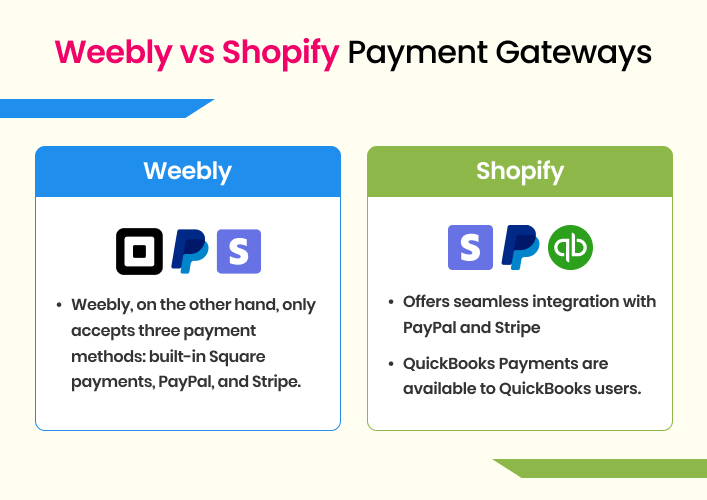
Shopify is the winner in the payment processing category. Only Shopify offers a comprehensive variety of payment processing options in the Weebly vs Shopify comparison. These are some examples:
  • Shopify Payments is built-in. PayPal and Stripe are two well-known payment services you can integrate into Shopify. QuickBooks Payments are available to QuickBooks users.

Weebly, on the other hand, only accepts three payment methods: built-in Square payments, PayPal, and Stripe. Furthermore, in order to utilize PayPal, you must be on Weebly’s highest-level Performance plan. Weebly’s free plans only accept Square payments, as Weebly is owned by Square.

Weebly vs Shopify – Support

When it comes to a support feature in Weebly vs Shopify, Shopify has an edge over Weebly. For example, you can receive help 24 hours a day, seven days a week by phone, email, or live chat. Weebly’s 24/7 assistance is restricted to email alone.

One drawback of Weebly support is that phone support is not available for the free plan. However, you can make a phone call or chat during business hours only. Weebly merchants get help from Weebly Community Forum and Support Center regarding their business growth, themes, SEO, and domains whereas Shopify business owners get assistance from the Shopify forum and Shopify changelog.

Conclusion

Weebly’s free plan is suitable for beginners with limited budgets, while Shopify offers robust marketing tools, customization options, and dedicated e-commerce features. With Shopify Payments integration, 24/7 customer support, and scalable plans, it is ideal for a competitive ecommerce landscape. So, choosing Shopify over Weebly will help you confidently build your online store and achieve e-commerce success.

FAQs

Which is cheaper, Weebly or Shopify?
Weebly is cheaper than Shopify with a free plan and paid plans starting at $10 per month.
Which is better: Weebly or Shopify?
Shopify is better for online stores, whereas Weebly is a good option for regular websites.
What is the difference between Weebly and Shopify?
Weebly is a website builder whereas Shopify is an e-commerce platform that allows you to sell online with its amazing marketing and SEO features.
Can you migrate the Weebly website to Shopify?
You can not migrate your site’s design but definitely you can migrate the Weebly website to Shopify by moving your products and orders using the CSV import and export feature.
Is Weebly free for eCommerce?
Yes, Weebly has a free plan but you need to pay transaction fees.

The post Weebly vs Shopify – A Brief Comparison appeared first on Alian Software.

]]>
Squarespace vs Shopify – What should you choose for your online store? https://staging.aliansoftware.net/design/squarespace-vs-shopify-what-should-you-choose-for-your-online-store/ Fri, 16 Jun 2023 15:28:11 +0000 https://aliansoftware.com/?p=29182 With more than 2 billion people regularly shopping online, it makes more sense than ever to launch the best e-commerce store. But it’s not enough to simply build an online store and expect your ideal customers to find it. As a business owner, you will need to include top-notch design, an easy-to-navigate menu, maximized SEO, and eye-pleasing aesthetics. Many platforms offer e-commerce options, but before choosing it is worth considering the reviews and after doing the analysis you can select your desired platform.

Squarespace is a general website builder that has e-commerce functionality, while Shopify is an entire platform geared toward helping customers to sell online. While both are solid options, they both have their distinct advantages and drawbacks. In this blog Squarespace vs Shopify, we’ll do a comparison to help you choose the right platform for you.

The post Squarespace vs Shopify – What should you choose for your online store? appeared first on Alian Software.

]]>

Squarespace vs Shopify – Introduction

Squarespace is a user-friendly website builder for people who want everything in one place. Subscriptions include a variety of pricing choices as well as layouts, site administration, and plugins. Furthermore, Squarespace has three degrees of e-commerce integration.

Shopify began as an online shop solution and has now expanded to an e-commerce website builder. Each of its plans has options for expanding an e-commerce site with an unlimited number of products and numerous sales channels. To customize the Shopify store, users can select from numerous layouts and themes.

Squarespace vs Shopify – Product Management

Adding products in Squarespace is easy with import tools or CSV but it is challenging to export them. Furthermore, if you have a large inventory, Squarespace will not be helpful. Thus, Shopify wins over Squarespace due to its product and inventory management features. Additionally, it doesn’t have any limitations while exporting products.

Squarespace vs Shopify – SEO Tools

Squarespace vs Shopify - What should you choose for your online store

Fully optimizing SEO is critical for business success, but it may be a difficult task without the assistance of support tools. Both Shopify and Squarespace provide users with integrated SEO help, however in different methods.

Shopify is designed to fulfill Google’s Core Web Vitals criteria. Three measures are included: page loading speed, responsiveness, and visual stability. Furthermore, Shopify analyzes a page’s content and provides suggested titles and meta descriptions depending on what it observes, saving the user time.

Squarespace customers have to manually adjust meta titles, descriptions, and custom URLs to fit their website content, but no suggestions are provided. Google Analytics is included with all plans, and the software supports simple social media integration. Thus, in terms of SEO, Shopify is better than Squarespace.

Squarespace vs Shopify – Marketing and Sales Channels

Both Squarespace and Shopify understand the importance of marketing and sales channels for your business. Squarespace provides basic marketing tools, including social media and Amazon integration but with limited features, email campaigns, and analytics.

While it covers the essentials, Shopify goes the extra mile by offering advanced marketing features such as discount code creation, customer segmentation, and multi-channel selling integrations with platforms like Amazon, eBay, and social media channels.

Squarespace vs Shopify – Payment Gateways and Transaction Fees

Squarespace vs Shopify - What should you choose for your online store
Squarespace integrates with payment gateways, including Stripe, PayPal, and Apple Pay, allowing you to offer various payment options to your customers. It charges a transaction fee ranging from 0-3% depending on the pricing plan, which can impact your profit margins. Some Transaction fees vary between Stripe, PayPal, Square, and Apple Pay.

On the other hand, Shopify offers a default payment method – Shopify Payments. Additionally, it allows integration of various third payment methods like Apple Pay, PayPal, Shop Pay, etc. It also allows integration with 100+ credit card payment providers. If you don’t use Shopify Payments you need to pay transaction fees ranging from 0.5% to 2%.

Conclusion

Finally, both Squarespace and Shopify provide useful features and tools for developing and maintaining your e-commerce store. Squarespace is a website builder that has visually appealing layouts, powerful SEO skills, and an easy-to-use blogging option. Shopify, on the other hand, offers a strong e-commerce platform with numerous app integrations, multi-channel selling, and powerful marketing capabilities.

Consider Squarespace if you prefer a solution with a straightforward price structure. Choose Shopify, on the other hand, if you need scalability, flexibility, and access to a large app ecosystem and generate high revenue from your online store.

FAQs

Which is better for dropshipping: Shopify or Squarespace?
Both Shopify and Squarespace integrate with major dropshipping firms. Shopify, on the other hand, provides a lot more, making it the superior alternative for individuals starting a dropshipping business and looking for the most product options.
Is Shopify as easy as Squarespace?
Yes, Shopify is easy to use in comparison to Squarespace.
Should I switch from Squarespace to Shopify?
Those can switch to Shopify which requires an all-in-one solution to sell online, in-store, or through social media. Squarespace is better suited for businesses that want a simple method of accepting payments but do not wish to commit to a long-term contract. Thus, you should switch to Shopify.
Should you use Squarespace or Shopify?
Shopify features more marketing tools than Squarespace to help you expand your online business. It has additional built-in email marketing features and offers you access to a plethora of applications. Shopify also outperforms Squarespace in terms of SEO functionality. Thus, choosing Shopify is the best decision.
Which is cheaper? Squarespace or Shopify?
The Squarespace basic plan starts from $18 per month and ranges to a premium plan at $69 per month. Shopify’s basic plan costs $29 per month and its advanced plan at $299 per month. Thus, Squarespace is a cheaper option but Shopify has advanced features making it value for money.

The post Squarespace vs Shopify – What should you choose for your online store? appeared first on Alian Software.

]]>
Top Social Media Marketing Strategies for Your Shopify Store https://staging.aliansoftware.net/design/top-social-media-marketing-strategies-for-your-shopify-store/ Mon, 12 Jun 2023 09:30:25 +0000 https://aliansoftware.com/?p=29112 In today's digital era, harnessing the power of social media has become crucial for businesses to achieve their digital marketing and business goals. A strong social media presence can significantly impact brand awareness, and customer engagement, and ultimately drive traffic to your website. To help you leverage this dynamic tool effectively, we've compiled a comprehensive list of top social media marketing strategies specifically tailored for Shopify users. In this blog post, we will explore the benefits of social media marketing, investigate the types of content that work best, and discuss how to engage your target audience across various social media platforms.

The post Top Social Media Marketing Strategies for Your Shopify Store appeared first on Alian Software.

]]>

Why is it important to do social media marketing for Shopify?

There are several reasons for your Shopify store’s social media marketing, but the most important is to increase brand recognition. Furthermore, it aids in the growth of your firm and the monitoring of your rivals’ actions. As a consequence, direct engagement with potential consumers is feasible, increasing the likelihood of conversion.

Understanding your targeted audience:

One of the most crucial foundations of social media marketing is to understand your targeted audience. Content may be tailored to the audience’s interests, needs, and preferences. This can be done by creating extensive research and doing an analysis of the client’s profile. This can further help you to create captivating content which will further result in engagement and finally lead to conversion.

Creating Engaging material for social media:

Creating Engaging material for social media
Creating material that is not only appealing but also engaging is one of the most difficult tasks. If the material is not intriguing, it will not provide the desired outcomes. To increase client trust, it is critical to generate material that allows consumers to contribute their opinions and ideas on the services and goods. This will contribute to the brand’s legitimacy. This can take the shape of a quiz, reviews, surveys, or even testimonials. Thus, this will increase consumer involvement.

Optimizing customer services:

Social media networks are a wonderful way to improve your customer service. You may demonstrate your dedication to providing great customer service by constantly monitoring and reacting to client inquiries, feedback, and issues in real-time. Prompt replies and personalized action on social media may considerably improve consumer satisfaction and loyalty, resulting in repeat business and favorable word-of-mouth referrals.

Selecting the most effective social media platforms:

All social media work differently. It is pivotal to identify the platform where we can easily find our targeted audience. You can choose from major platforms like LinkedIn, Facebook, Twitter, Instagram, and YouTube. This will not only significantly boost your reach but also the chance of interactions for your business. Each platform has something unique to offer with additional benefits which is the need for the business.

Establishing the identity of the brand on social media:

Establishing the identity of the brand on social media
Maintaining a consistent brand identity throughout all social media platforms is quite challenging. Ensuring the brand’s aspect, tone of voice, and visuals relate with your whole brand posts, profile photo, and even the cover images. By doing so you can build the trust of your audience. Consistency posting is the key to success.

Experimenting with social media:

You can’t find out what people think of what you create unless you share it on the right social media sites. Thus, after caring out the experiment, you can conclude what attracts your customers. So you can start creating that content more. Once the engagement is started it will take no time for the business to flourish. The feedback from the customer has a significant role.

Preparing the data:

Preparing the data
After completing all the required steps, it’s important to have the data ready to assess the performance of your posts. This will enable you to determine which posts are more successful and understand the preferences of your audience. It will reveal what captures their attention. Without this data, you won’t be able to track your progress. It’s like accepting a difficult situation without any concrete numbers or information.

Adjust your strategy:

Finally, after learning about your audience’s preferences, you may make changes to your plan. You may produce and upload material based on what your audience loves and hates. The main goal of generating content is to increase conversion and, ultimately, sales. By doing so, your business may reach new heights, giving you a sense of accomplishment, pride, and happiness.

Conclusion

In conclusion, social media marketing holds immense potential for Shopify businesses to enhance their online visibility, connect with their desired audience, and attract more visitors to their websites. By getting to know your target customers, creating interesting content, providing excellent customer service, choosing the appropriate social media platforms, and maintaining a consistent brand image, you can make the most of social media marketing. It’s important to remember that these effective strategies require ongoing monitoring, analysis, and adjustment to keep up with the constantly evolving digital world. So, start implementing these strategies now and see how they positively impact your Shopify business.

FAQs

How do I market my social media on Shopify?
Start promoting social media profile, collaborating with influencers, executing advertisements, and engaging with audiences to market social media on Shopify.
What social media platforms does Shopify use?
Shopify helps in promoting and selling on Facebook, Instagram, TikTok, Google, and YouTube.
What are the 4 pillars of social media strategy?
The 4 pillars are promotional, educational, entertainment, and inspirational content go very well with the social media strategy.
What are the 6 Cs of social media marketing?
The 6 C’s of social media are Content, commerce community, collaboration, conversion, and customization.
What makes a successful social media strategy?
To create a successful social media strategy, you must first set clear goals and objectives. Without goals, you won’t be able to gauge success or determine your return on investment (ROI).

The post Top Social Media Marketing Strategies for Your Shopify Store appeared first on Alian Software.

]]>
Email Marketing Strategies for Increasing Revenue on Shopify https://staging.aliansoftware.net/design/email-marketing-strategies-for-increasing-revenue-on-shopify/ Thu, 08 Jun 2023 15:30:15 +0000 https://aliansoftware.com/?p=28947 As there has been a rise in the competition, to increase revenue and bring more sales to the table, it is very crucial that businesses have effective strategies in this cut throat competitive world. Out of the many strategies, one can try hands-on is Email marketing apart from social media. Not only Shopify store owners can maximize their customer’s engagement but they can also boost conversion and maintain long-term relationships by making use of different email marketing strategies. We will explore the main email marketing strategies in this blog which can help you to maximize your Shopify store’s revenue.

The post Email Marketing Strategies for Increasing Revenue on Shopify appeared first on Alian Software.

]]>

Getting Started with Email Marketing

To kickstart your email marketing journey, it is crucial to build a customer base by collecting email addresses through various channels.
  • Offer incentives like discounts or exclusive content in exchange for signing up for your newsletter.
  • You can collect emails from professional sites like LinkedIn or Lusha.
  • Use a reliable email marketing tool to manage and automate your email campaigns efficiently.

Creating Engaging Email Campaigns

Creating Engaging Email Campaigns

One can not forget to grab the attention of the customer by making it personalized. Emails that provide value to your subscribers, such as useful information, special discounts, or new product updates, may help keep your business at the forefront of their minds. Customization of the content is also necessary for increasing open and click-through rates. By doing so it will help you to know the preferences and the purchasing behavior of the customer. To increase open and click-through rates, you can customize your email as per the preference of the customers.

Emails for abandoned cart

Email is a highly effective approach to gaining potential revenue that may have otherwise been lost. These automated emails serve as reminders to customers regarding their unfinished purchases and offer incentives, such as discounts or free shipping, to encourage them to finalize their transactions. Implementing abandoned cart email sequences can significantly enhance conversion rates and contribute to overall revenue growth.

Optimizing Transactional Emails

Transactional emails, such as order confirmations, shipping notifications, and delivery updates, present valuable opportunities to promote additional products or related offers. Utilize transactional emails as a marketing channel by including personalized recommendations, cross-selling, or upselling suggestions. This can help drive incremental sales and increase customer engagement.

Timing and Segmentation

For maximum engagement and conversion, timing is very crucial. If you are targeting a specific group audience, it is pivotal to segment your email list on the basics of demographics, purchase history, and browsing habits. You can send customized emails with relevant offers and content, after the understanding of your audience. This will help the chances of positive conversion.

An effective call to action

An effective call to action
An effective email marketing campaign must have a clear and compelling call to action. Using action-oriented language and visually appealing buttons and banners will help you drive more conversions like making a purchase, signing up for the webinar, and even downloading a resource. Click-through rates and conversions are highly influenced by the well-designed and strategically placed call to action.

Email Marketing with Social Media Integration

If you want to increase your conversion rate and the result, it is very crucial to combine it with your social media presence. Your objective of motivating readers to share your information with the network would only be fulfilled after adding appealing content and social sharing buttons to it. To increase your communication with clients and your followers, it is advisable to advertise your social media profiles in your emails.

Incorporating different types of Emails

To maintain the interest of your clients, it is crucial to diversify your emails. In addition to advertising emails, you can also include some interesting stuff like client testimonials and user-generated content. To enhance the participation of your clients, you can also send surveys and feedback request forms.

Conclusion

Email marketing remains a powerful and cost-effective strategy for driving sales and increasing revenue on Shopify. By employing the strategies discussed above, such as regular email campaigns, leveraging automation, optimizing open and click-through rates, and personalizing content, you can build a strong email marketing strategy that engages your customer base and maximizes your ROI. With careful planning, consistent execution, and continuous optimization, email marketing can become a significant revenue driver for your Shopify store.

FAQs

How to increase revenue with email marketing?
To increase revenue with email marketing, focus on building a targeted and engaged subscriber list, personalize your email campaigns to deliver relevant content, and include compelling call to action that drive conversions.
Can you send marketing emails with Shopify?

Yes, you can send marketing emails with Shopify. While Shopify itself does not have built-in email marketing capabilities, it integrates with various email marketing services that allow you to send marketing emails to your customers. These services, such as Klaviyo, Mailchimp, and Omnisend, provide the necessary tools and features to create and send email campaigns directly from your Shopify store. By connecting your Shopify store with an email marketing service, you can effectively engage with your customers, promote your products, and drive sales through email marketing.

Which email marketing service is the best for Shopify?
There are various email marketing providers that work well with Shopify, but some of the most popular alternatives include Klaviyo, Mailchimp, and Omnisend. The ideal option is determined by your unique requirements, budget, and desired features. It’s a good idea to evaluate the features and costs of various platforms to see which one works best with your Shopify store.
Does Shopify give free business email?
Shopify does not provide free business email accounts as part of its standard offerings. However, you can set up a professional business email through third-party email hosting providers, such as G Suite (now Google Workspace) or Microsoft 365, and connect it to your Shopify domain. These email hosting services typically have monthly subscription fees associated with them.
Can customers reply to Shopify emails?
No, customers cannot directly reply to standard notification emails sent from Shopify.

The post Email Marketing Strategies for Increasing Revenue on Shopify appeared first on Alian Software.

]]>
5 Best E-commerce Platforms For Your Online Business https://staging.aliansoftware.net/design/5-best-ecommerce-platforms-for-your-online-business/ Fri, 02 Jun 2023 15:30:55 +0000 https://aliansoftware.com/?p=28612 If you're thinking of starting an online store, picking the right platform is super important. In this blog post, we'll check out the five best e-commerce platforms that can help you create a fantastic online store. Whether you're a small business owner or dreaming of starting your own business, these platforms offer a variety of options to suit your needs. To assist you, we have gathered the top five e-commerce systems in one location.

The post 5 Best E-commerce Platforms For Your Online Business appeared first on Alian Software.

]]>

Shopify

Shopify

Shopify is a really great online platform for businesses that want to sell their products. It’s used by over 600,000 online shops and has millions of active users all around the world. Shopify has generated over $100 billion in sales, which shows that it’s very successful.

One of the best things about Shopify is its sales features. It has a wide range of tools that can help you manage your inventory and sell your products through different channels. Customers seem to love it too, as Shopify has a very high satisfaction rating of 93%.

Shopify offers different pricing options, and while it may seem a bit expensive, many people believe it’s worth the investment. They even offer a free trial and a special deal where you can get the basic plan for just $1 for three months, so you can try it out and see if it’s the right fit for your business.

For larger businesses with more complex needs, there’s Shopify Plus. It’s an advanced version of Shopify designed for high-volume businesses. It has a variety of features and can handle big operations while ensuring reliability and security. Shopify Plus is becoming more and more popular because of the great functionality it offers.

Overall, Shopify is a powerful and user-friendly platform that can help businesses of all sizes sell their products online. It’s definitely worth considering if you’re looking to start or expand your online store.

Squarespace

Squarespace

It is considered as the best overall platform for stunning designs.

One of the primary reasons people choose Squarespace is the website builder. The simple drag-and-drop interface allows you to easily customize the website Squarespace’s award-winning templates without knowing HTML, JavaScript, or CSS. There are over 100 of these templates, with new ones being updated on a regular basis. It provides a template for you whether you need one with a blog, a portfolio, an e-commerce site, or all three.

However, some customers argue that because so many of the designs look the same, it’s simple to recognise when a site is built using Squarespace. The easiest approach to avoid this is to make certain that your site has a consistent color palette and branding that helps it stand out.

Woocommerce

Woocommerce

WooCommerce is a WordPress plugin that is free to use. However, you will still have to pay additional costs to get started. WooCommerce cost includes a domain name, hosting, an SSL certificate, a theme, design, and additional plugins to help with shop administration. It is one of the most widely used open source e-commerce platforms. Because open-source is free, you maintain complete control of your store’s content and data.

Use WooCommerce for a shop that powerfully integrates content and commerce, whether you’re beginning a business, moving brick-and-mortar retail online, or designing sites for clients.

It comes with various features, like it creates appealing storefronts with themes that are appropriate for your brand and business. Moreover you can increase income by optimizing the shopping cart experience. It can also allow you to customize product pages in minutes.

Bigcommerce

Bigcommerce

BigCommerce is a well-known hosted eCommerce platform that offers merchants and retailers software-as-a-service (SaaS). Bigcommerce comes with a powerful website builder that gives you the freedom to modify even the smallest detail. It has 12 free templates and the paid version ranges from $150 to $400 . If you are confident and tech survey you can use it to its full potential. It also has some of the payment gateways such as Paypal, Amazon and Stripe. Alternatively store owners can set their payments methods by bank transfer or check. Overall, BigCommerce allows you to create fully-detailed make listings on the back end, while buyers have enhanced power to discover exactly what they are searching for on the front end. This makes the platform an excellent choice for large organizations seeking rapid development without sacrificing performance.

Wix

Wix

Wix is widely regarded as one of the top eCommerce platforms for small enterprises with limited inventory and a wide range of tools. It stands out as end to end web development for your business goal, empowering users to create fully functional eCommerce websites. Wix is particularly well-suited for small businesses and aspiring entrepreneurs who desire a robust website builder that seamlessly integrates eCommerce features.

Wix boasts a range of powerful capabilities that enhance the eCommerce experience. These include advanced features like order tracking, abandoned cart recovery, dropshipping, print-on-demand services, and automated sales tax calculations. Moreover, Wix offers a vast selection of over 800 professionally designed website templates, many of which are available for free. Alternatively, users can leverage Wix’s Artificial Design Intelligence (ADI) to effortlessly create their websites by answering a few simple questions.

Conclusion

In conclusion, when it comes to choosing the best eCommerce platform, Shopify stands out as the top choice. With its extensive range of features, user-friendly interface, and robust functionality, Shopify provides a seamless and efficient online selling experience. It offers a wide array of customizable themes, a secure payment gateway, reliable customer support, and extensive app integrations, making it a comprehensive solution for businesses of all sizes. Shopify’s reputation as a leading eCommerce platform is backed by its strong track record and positive user feedback. Its versatility and scalability make it an ideal choice for businesses looking to establish and grow their online presence. Therefore, selecting Shopify ensures a reliable and effective eCommerce platform that meets the needs of businesses in a competitive online marketplace.

FAQs

What is the most successful eCommerce platform?
Shopify and BigCommerce are the successful eCommerce platforms.
Which eCommerce business is best?
Clothing, gym products, coffee, candles, ecofriendly items, etc are the best eCommerce business.
Who is the biggest eCommerce seller?
Amazon is the biggest eCommerce seller.
What is the easiest ecommerce platform to use?
Shopify is the easiest one. You don’t have to know technical aspects for developing a store on it.
Which ecommerce platform is best for small businesses?
WooCommerce is best for small businesses.

The post 5 Best E-commerce Platforms For Your Online Business appeared first on Alian Software.

]]>